 Off to the Rugby
Rugby union
Principality Stadium
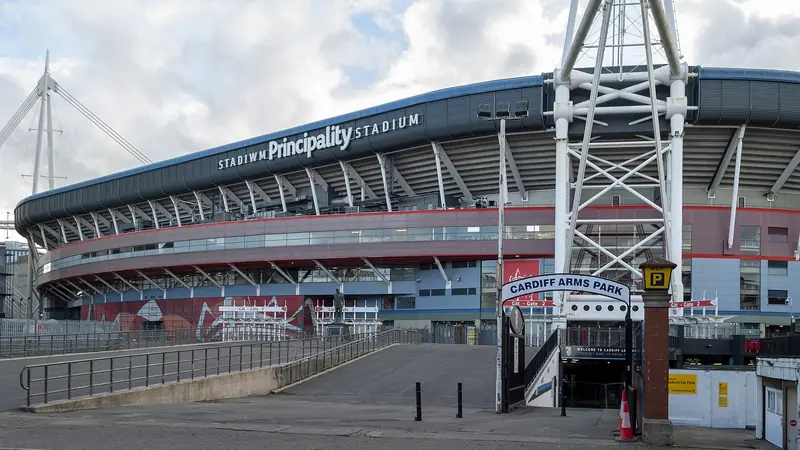
Principality Stadium puts Welsh international rugby five minutes’ walk from Cardiff Central, right in the city centre. Its steep seating and retractable roof frame a ground associated with Grand Slams and European finals.
By Does Your Duck Quack · Updated 14 October 2026
Principality Stadium at a glance
Sources: Confirmed · Principality Stadium: Facts and Figures · Principality Stadium: Getting Here · Principality Stadium: Contact Us · Principality Stadium: Throwback Thursday: Wales 29 South Africa 19 · Welsh Rugby Union: Welsh Rugby Union - Principality Stadium officially unveiled · Principality Stadium: Principality Stadium Tour · Tiny Rebel: Tiny Rebel Cardiff · Checked on 14 October 2026.
Plan your visit
Official tickets and venue informationSome links earn us a small commission at no extra cost to you.
Confirmed · Principality Stadium: Home - Principality Stadium
Before you travel
- Allow the stadium’s five-minute walk from Cardiff Central to reach the ground.
- Turn left on Wood Street for Gates 5–7, or towards Westgate Street for Gates 2–4.
- Use Cardiff Bus’s event stops: 21, 23 and 24 at Greyfriars Road GN during the published diversion.
- Ask about ambulant seats in L12 or L27 with extended handrails.
- Use the Level 6 concourse for the Now in a Minute food-and-drink stores.
Confirmed · Principality Stadium: Getting Here · Cardiff Bus: Major City Centre Events · Principality Stadium: Accessible Facilities · Principality Stadium: Principality Stadium launches Wales' first checkout-free stores · Checked on 14 October 2026.
A national stadium rebuilt in the centre of Cardiff
The first match at the new Millennium Stadium was Wales against South Africa on 26 June 1999. Wales won 29–19, their first victory over the Springboks, with Rob Howley captaining the team and Neil Jenkins contributing 19 points. Mark Taylor scored the stadium’s first try and Gareth Thomas the other Welsh try. The ground was still being completed: its own anniversary account puts the restricted opening capacity at 28,000, far below the finished stadium’s seated capacity.
The WRU began examining redevelopment in 1994 and secured the 1999 Rugby World Cup hosting rights in 1995. The old National Stadium held 53,000, including an 11,000-capacity standing East Terrace. Options included an additional tier or an entirely new location, but the chosen scheme rebuilt the existing city-centre site. The pitch orientation turned through 90 degrees, while demolition of the Empire Pool at Wood Street and Park Street created space for a new entrance plaza.
The stadium filled in stages during the summer of 1999. Wales beat France 34–23 in a warm-up watched by 62,500, before the World Cup opener against Argentina on 1 October drew 72,500 and ended 23–18 to Wales. The stadium also witnessed Neil Jenkins pass Michael Lynagh’s international scoring record during that tournament’s pool match against Samoa.
Wales completed the 2005 Grand Slam here by defeating Ireland 32–20, ending a wait stretching back to 1978. The Six Nations’ account identifies this as a victory over opponents Wales had not beaten since 2000. The team was coached by Mike Ruddock and captained in the closing stages of the campaign by Michael Owen.
The 2005 Ireland match was not a high-scoring try contest: each team scored two tries and converted both. Wales added five penalties and a drop goal, compared with Ireland’s two penalties. The IRFU’s match statistics record ten Welsh turnovers against two for Ireland, with Martyn Williams making 14 tackles and Stephen Jones 12.
Wales defeated England 30–3 here in the 2013 Championship decider. England arrived seeking a Grand Slam; Wales needed to win by at least seven points to take the title themselves. The hosts led 9–3 at half-time, then Alex Cuthbert scored twice during the second half. Justin Tipuric helped create both tries, first releasing Cuthbert with a pass and then opening space after Sam Warburton’s break. The final margin comfortably exceeded the requirement for the championship.
The kicking points in that 2013 match came from Leigh Halfpenny and Dan Biggar. Halfpenny landed four penalties before Biggar contributed a penalty, conversion and drop goal after Halfpenny took a knock. England’s only score was an Owen Farrell penalty. Wales had begun that same tournament by losing at home to Ireland, so the final afternoon brought a successful defence of the championship without a Welsh Grand Slam.
The 25–7 victory over Ireland in March 2019 secured Wales another Grand Slam at Principality Stadium. World Rugby’s following rankings update placed Wales second, matching their previous high position, and recorded that the victory extended their winning sequence to 14 Tests. It was the third Grand Slam under Warren Gatland.
Gareth Anscombe supplied 20 points in the 2019 decider through six penalties and the conversion of Hadleigh Parkes’s early try. RTÉ reported wind and rain over Cardiff, with the roof left open after Ireland requested that arrangement.
European club rugby has repeatedly used this stadium for its final. The WRU’s anniversary account lists the 2002, 2006, 2008, 2011 and 2015 finals at the Millennium Stadium, while distinguishing the 1996 and 1997 finals played at the old National Ground. Its record for the 2002 Leicester Tigers–Munster final is 74,600 spectators. That is a historical event attendance and should be read separately from the venue’s current published seated capacity of 73,931.
Wales completed the 2008 Grand Slam with a 29–12 victory over France in Cardiff. The game was still level at 9–9 with roughly half an hour remaining. Shane Williams then reacted to a loose ball inside the French 22, kicked it towards the posts and gathered to score. That try took him to 41 for Wales, passing Gareth Thomas at the top of the national list. Stephen Jones added the conversion. Mark Jones later carried to within a metre of the line, before Martyn Williams collected another loose ball and scored under the posts. James Hook contributed three penalties; Stephen Jones kicked two penalties and converted both tries. France’s points all came from penalties. Wales had conceded just two tries across the entire five-match championship, finishing Warren Gatland’s first Six Nations in charge unbeaten. Shaun Edwards and Rob Howley were also part of the coaching team. Gavin Henson spent ten minutes in the sin bin, and Wales replaced Hook with Stephen Jones in the second half. France’s starting half-backs were David Skrela and Jean-Baptiste Élissalde, with Dimitri Yachvili coming on later.
Italy’s first victory in Cardiff came on 19 March 2022, when a late break by Ange Capuozzo turned a Welsh lead into a 22–21 Italian win. Capuozzo escaped from deep and passed to Edoardo Padovani, who scored between the posts. Paolo Garbisi converted to end Italy’s sequence of 36 Six Nations defeats. Earlier, penalties by Garbisi and Padovani had given Italy a 12–7 half-time lead. Welsh tries from Dewi Lake and Josh Adams helped the hosts recover, with Dan Biggar’s conversion of Adams’s try putting Wales 21–15 ahead. The final counterattack overturned that six-point advantage. The match also marked Alun Wyn Jones’s 150th appearance for Wales and Biggar’s 100th cap. Jones was the first Welsh player to reach that national-team milestone. Owen Watkin had scored Wales’s first try, briefly moving the home side ahead after Italy’s opening two penalties. Italy responded with another pair of successful kicks before the interval. Their captain was Michele Lamaro, and Kieran Crowley was the head coach who oversaw the breakthrough.
Confirmed · Principality Stadium: Throwback Thursday: Wales 29 South Africa 19 · Principality Stadium: About the Venue · Six Nations Rugby: Where are they now? Wales’ 2005 Grand Slam winners - Guinness Men's Six Nations · Irish Rugby: Match Stats: Wales 32 Ireland 20 · Lions Rugby: Wales win title in style - The British & Irish Lions Website · World Rugby: Triumphant Wales claim second place in rankings · Welsh Rugby Union: Welsh Rugby Union - Principality Stadium celebrates 25! · Dragons RFC: Glory for Wales as the Grand Slam is Won · Reported · RTE: RTÉ 2019 Grand Slam report · Rai News: Rugby, impresa dell'Italia: Galles battuto 22-21 · Checked on 14 October 2026.
Steep tiers, the closing roof and two rugby codes
Populous describes the bowl as steeply tiered and close around the pitch, with a roof insulated to enhance the acoustic effect when closed. The design brief required a major rugby venue on a particularly constrained city-centre site in time for the 1999 World Cup. The roof and compact seating geometry were therefore part of the architectural response to Cardiff’s location.
The Principality Stadium name was formally unveiled in January 2016, with Warren Gatland switching on the external signage reading Stadiwm Principality Stadium. Mark Taylor, scorer of the opening try in 1999, attended alongside Ryan Jones. The stadium was previously called Millennium Stadium.
The ground belongs to rugby league history too. Hull FC’s retrospective identifies Paul Cooke’s late try as the decisive moment in the 25–24 Challenge Cup final victory against Leeds in 2005. Cooke described the Cardiff final as a day he would never forget.
The stadium’s wider sporting programme included six FA Cup finals, seven League Cup finals and seven years of Football League play-off finals while Wembley was being replaced. It also hosted Olympic football in 2012, the Champions League final in 2017 and world-title boxing. The WRU’s 25-year review counts 21 British Speedway Grands Prix and three rugby league Challenge Cup finals.
The roof protocol changed in January 2025. Principality Stadium announced that Wales internationals would be played with it closed for the following two years, under an agreement with Six Nations. Previously, the stadium had sought agreement with the visiting team before deciding whether to open or close it. The new default covered both senior men’s and women’s internationals. The announcement coincided with the final tickets being sold for Ireland’s February 2025 visit; the England match had sold out before Christmas. Stadium manager Mark Williams linked the change to the sound generated inside the enclosed bowl. The WRU also identified consistent conditions for spectators and players as a reason for adopting the closed-roof policy.
Confirmed · Populous: Populous stadium design · Welsh Rugby Union: Welsh Rugby Union - Principality Stadium officially unveiled · Hull FC: Paul Cooke On The Challenge Cup Final He Will "Never Forget" - Hull FC News · Welsh Rugby Union: Welsh Rugby Union - Principality Stadium celebrates 25! · Principality Stadium: Iconic Principality Stadium roof to be shut for all Wales fixtures as Ireland’s visit completes Guinness Six Nations sell-out in Cardiff · Checked on 14 October 2026.
Five minutes from Cardiff Central, with gates on different streets
Cardiff Central is the nearest railway station, and the stadium gives a five-minute walk from the station to the ground. Its directions split at Wood Street: turn left for Gates 5, 6 and 7, or right towards Westgate Street for Gates 4, 3 and 2. Gate 1 is reached by continuing around towards Castle Street.
Cardiff Queen Street is another rail option, described by the stadium as approximately 15 minutes away on foot and serving local routes through Cardiff and the South Wales Valleys. The venue says Cardiff Central normally operates a queuing system after stadium events. Its driving information also makes clear that there is no dedicated spectator car park at or immediately beside the ground, while Cardiff Council organises event park-and-ride services for larger occasions.
Transport for Wales independently identifies Cardiff Central as the closest station and repeats the five-minute walk. Its stadium guide describes connections with Welsh railway lines and routes towards Manchester and London.
Cardiff Bus publishes a distinct diversion plan for major Principality Stadium events. In that plan, services 21, 23 and 24 use Greyfriars Road stop GN, while route 32 terminates at Fitzhamon Embankment. Routes 44 and 45 use Churchill Way stop HM, and 49 and 50 use stop HL on the same street. These are event arrangements associated with road closures, rather than the ordinary positions of every service when Westgate Street is open.
The same major-event bus plan places services 61, 62 and 63 at Fitzhamon Embankment, with outbound diversions through Tudor Street and Clare Street. Routes 92, 92B, 93 and 94 use Tudor Street. The operator lists Westgate Street and the Cardiff Bus Interchange among stops omitted by several diverted services. The last part of a bus journey can therefore move to the west side of the River Taff or to the east of the shopping centre, depending on the route.
Our advice (opinion): We would choose Cardiff Central for a rail arrival and follow the Wood Street split towards the ticketed gate; this ground rewards knowing which side of the city-centre bowl you need.
Confirmed · Principality Stadium: Getting Here · Transport for Wales: Transport for Wales stadium guide · Cardiff Bus: Major City Centre Events · Checked on 14 October 2026.
Now in a Minute stores, water points and Westgate Street pubs
The stadium announced its Now in a Minute stores in August 2026, with the outlets located on the Level 6 concourse. They use Amazon Just Walk Out technology: a payment card opens entry, sensors register the goods selected, and payment is processed without a conventional till queue. The published range includes pies, confectionery, soft drinks and alcoholic drinks, with products varied for different events. The store name deliberately uses a familiar Welsh expression.
The checkout-free shops were developed with Aramark UK, and their launch announcement also records more than 20 self-service eBars across the stadium. Former Wales international Scott Quinnell tried the technology ahead of the public launch.
Aramark became the stadium’s food, drink and hospitality partner under an agreement announced in November 2025 and scheduled to begin that December. The WRU described the contract as covering food service, technology and sustainability targets for waste, energy and packaging, and thanked previous supplier Levy.
For Welsh rugby matches, the stadium says food and drink outlets close within 15 minutes of the second half starting, with limited flexibility to clear queues. Free drinking-water stations remain available, and supporters needing food or drink for medical reasons are directed to a steward.
Tiny Rebel Cardiff is at 25 Westgate Street, Cardiff CF10 1DD. Its official page offers table booking and separate main, children’s and Sunday menus. The address places the bar on the same street as the stadium’s eastern approaches, close to the city-centre end of the matchday walk. The brewery’s own venue page distinguishes this Cardiff bar from its Newport brewery taproom, which is a separate destination outside the stadium neighbourhood.
Tiny Rebel dates the Cardiff bar’s opening to 2013 and describes it as a venue used by supporters before matches and concerts at Principality Stadium.
The City Arms is on Quay Street, Cardiff CF10 1EA, with live sports coverage and table ordering described on its current website. The address puts it in the streets immediately east of the stadium rather than at Cardiff Arms Park’s clubhouse. The pub’s site lists a telephone contact of 029 2064 1913 and identifies the venue as part of the Marston’s pub group.
Principality Stadium defines a small permitted bag as no larger than 35 by 40 by 19 centimetres, or a standard handbag. Its security guidance says there is no bag storage at the stadium.
Confirmed · Principality Stadium: Principality Stadium launches Wales' first checkout-free stores · Principality Stadium: Aramark UK named as new food, drink and hospitality partner for Principality Stadium · Principality Stadium: Fanzones & Facilities · Tiny Rebel: Tiny Rebel Cardiff · Tiny Rebel: Tiny Rebel Bars - Tiny Rebel Brewing · City Arms Cardiff: Sports pub in Cardiff · Principality Stadium: Safety and Security at the Stadium · Checked on 14 October 2026.
Three tiers, seven levels and a movable roof
The stadium publishes a seated capacity of 73,931, divided into 35,151 upper-tier seats, 15,626 middle-tier seats and 23,154 lower-tier seats. The upper tier is at Level 6 and the middle tier spans Levels 4 and 5. The same inventory lists four stands, seven levels, 112 private hospitality suites and seven hospitality lounges.
Four 90-metre masts form part of the stadium structure. The official construction figures list 40,000 tonnes of concrete, 12,000 tonnes of structural steel and 4,000 tonnes of reinforcement. The retractable roof covers 8,960 square metres and creates an opening of 105 by 80 metres, with a published opening time of 20 minutes. The bowl’s north–south orientation resulted from turning the playing area through 90 degrees during redevelopment of the former National Stadium site.
The architects link the closeness of the steep seating tiers with clear views of the playing area and the compact use of the site. Their project description also identifies the closing roof as the first of its kind in the United Kingdom.
The stadium access statement identifies public viewing levels as 3, 4 and 6, each containing wheelchair positions with companion seating. The ticket office is separate from the main bowl: it is reached through the WRU shop on Westgate Street and sits on the first floor, with both stairs and an accessible lift. Event stewards provide guidance there.
Confirmed · Principality Stadium: Facts and Figures · Populous: Populous stadium design · Principality Stadium: Stadium access statement · Checked on 14 October 2026.
Accessible plazas, L12 and L27, and Changing Places
The stadium’s accessible approaches use the Riverwalk to Gate 1 from the north, Westgate Plaza to Gate 3 from the east and Millennium Plaza to Gates 6 and 7 from the south. The plazas are described as step-free, with ramp gradients no steeper than 1:20. Accessible lanes form part of the ordinary entry gates. For WRU-operated events, ambulant seating is offered in L12 and L27, where extended handrails assist movement within the blocks.
Principality Stadium’s Changing Places facility includes a bench, hoist, shower, grab rails and a floor-level emergency assistance alarm, with access by Radar key. The venue identifies accessibility stewards by their black-and-white tabards. It also uses Nimbus Access Card information for accessible ticketing, including companion needs and assistance-animal seating. Assistance dogs are accommodated on wheelchair terracing where there is sufficient space, while commentary earpieces and referee-link microphones can be requested for eligible WRU-event customers.
The access statement says stewards carry Radar keys for visitors who do not have their own. It also records accessible counters at food and drink outlets, accessible toilets throughout the building and an ambulant-accessible cubicle in each toilet block. The document explains that event road closures prevent a direct stadium drop-off, so a vehicle collection point may lie some distance away.
Confirmed · Principality Stadium: Accessible Facilities · Principality Stadium: Stadium access statement · Checked on 14 October 2026.
The Parkgate across Westgate Street
The Parkgate Hotel reuses Cardiff’s former Head Post Office and old County Court on Westgate Street. The post office was completed in 1897 for Queen Victoria’s Diamond Jubilee and designed by Sir Henry Tanner, using Portland stone. It became Grade II listed in 1975. Its roofline includes figures connected with Cardiff’s working life: a miner and a man with a mail ship, alongside a telephonist and postman on the Parkgate gable.
The hotel stands on Westgate Street at CF10 1DA, across the road from the stadium, and gives its own walking estimate of seven minutes from Cardiff Central. It does not provide an on-site car park, valet service or a front-door baggage drop-off. Its arrival guidance says guests cannot load or unload bags directly in front of the building. The short walk to the ground therefore comes with the constraints of a hotel inside Cardiff’s event-closure area.
Parkgate lists nine accessible bedrooms close to passenger lifts. Four connect to an adjacent room through an internal door; five contain a single sofa bed for a companion. The accessible rooms have wet rooms, grab rails and emergency alarms, with switches and sockets at accessible heights. The hotel also offers Deluxe King rooms with twin beds on request and family suites with separate sleeping arrangements, giving several specifically described options for rugby visitors travelling together.
Some of Parkgate’s named suites have unusually direct connections with the surrounding buildings. The Deluxe Junior Suite with Balcony overlooks a skyline including Principality Stadium and Cardiff Castle. The Tower Suite occupies the former post office’s bell tower, retaining features including a fanlight window, exposed metal beams and restored parquet flooring.
The Parkgate Hotel opened through a collaboration involving the WRU, developer Rightacres and the Celtic Collection, the hospitality group associated with Celtic Manor. Its opening announcement linked the hotel with Wales international hospitality, including pre-match and post-match use of the building’s function suite and stadium seating.
Confirmed · The Parkgate Hotel: History and Heritage · The Parkgate Hotel: Contact Us & Helpful Information · The Parkgate Hotel: Rooms · The Parkgate Hotel: Doors Open to First Guests · Checked on 14 October 2026.
Tours, stadium names and the national-ground address
The regular stadium tour goes through the Wales home changing room and players’ tunnel before reaching the pitchside area. Another named stop is the Ray Gravell Press Conference Suite. The official description covers rugby, boxing, football, motorsport and concert history, reflecting the building’s different uses since 1999. Tour bookings are separate from match admission, and the stadium asks people with access requirements to contact the tour team before a group booking is made.
The stadium’s published ground rules prohibit prams and pushchairs inside. Children older than two require their own event ticket, while the rules allow under-twos to sit on an adult’s lap. They also restrict outside food and drinks unless an exception is granted, and identify service dogs and guide dogs as exceptions to the animal ban.
Cardiff Arms Park and Principality Stadium share the history of the wider Arms Park site, but the national stadium is the rebuilt venue whose first match was played in 1999. The earlier National Ground hosted the first European club final in 1996. The current venue’s public address is Westgate Street, Cardiff CF10 1NS. For a Cardiff club match, the separate Arms Park ground next door is a distinct destination, even though both sit within the same central rugby neighbourhood.
Continue with Cardiff Arms Park, the Six Nations or rugby accommodation.
Our pick (opinion): For a visit beyond the match, we would choose the stadium tour for its changing-room, tunnel and Ray Gravell suite stops.
Confirmed · Principality Stadium: Principality Stadium Tour · Principality Stadium: Ground Rules · Principality Stadium: About the Venue · Checked on 14 October 2026.
Choose your overnight base
Some links earn us a small commission at no extra cost to you.