 Off to the Rugby
Rugby league
Wembley rugby league guide
Wembley turns rugby league’s Challenge Cup final into a national-stadium occasion beneath its enormous arch. The rugby league statue and three-tier bowl connect the sport’s past with the scale of today’s venue.
By Does Your Duck Quack · Updated 14 October 2026
Wembley Stadium at a glance
Sources: Confirmed · Wembley Stadium: Stadium Facts · Wembley Stadium: England v Czechia · Wembley Stadium Foundation: Contact Us · Wembley Stadium: Wembley stadium facts · Wembley Tours: Wembley Stadium Tours · Fullers: Take a look inside The White Horse Wembley - Fuller's · Checked on 14 October 2026.
Plan your visit
Official tickets and venue informationSome links earn us a small commission at no extra cost to you.
Confirmed · Wembley Stadium: Official visitor information
Before you travel
- Use Wembley Stadium station for the stadium’s published four-minute walk; Wembley Park is a different station.
- Keep a Wembley personal bag within 297 × 210 × 210mm, or arrange the medical exemption certificate.
- Match your food plans to your level: M&S Food and TapHouse Social require Level 2 tickets.
- For the Wembley Park accessible shuttle, use the Rutherford Way and Engineers Way drop-off information.
- Choose the standard tour rather than an Express Tour if access to Wembley dressing rooms is essential.
Confirmed · Wembley Stadium: England v Czechia · Wembley Stadium: Bag policy · Wembley Stadium: Stadium Guide · Wembley Stadium: Wembley Stadium travel information for guests with access requirements · Wembley Tours: Wembley Stadium Tours · Checked on 14 October 2026.
Wembley’s rugby history: the original stadium and the arch
Wembley is England’s national football stadium, with 90,000 seats, and its rugby identity centres on major events, particularly the Challenge Cup final. The stadium’s own history includes the 2015 Rugby World Cup among its landmark competitions. Rugby visitors therefore enter a national sporting venue with a substantial history in both codes, even though England’s football team is its resident international side and the building is not a club rugby home.
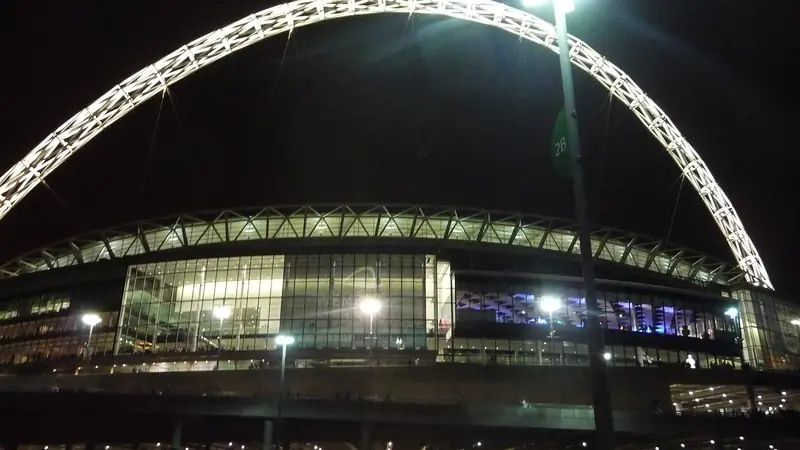
The present stadium opened in 2007, replacing the older ground with its twin towers. Its most recognisable feature is the arch above the north stand: 133 metres high, with a 315-metre span. The arch carries the north roof’s full weight and part of the southern roof, allowing the seating bowl to be free of view-blocking support pillars. The change from towers to arch marks two separate buildings on the same sporting site.
Rugby league’s move to Wembley began with a decision to bring the 1929 Challenge Cup final to London. The RFL’s account identifies Fred Kennedy, then its chairman and a Broughton Rangers official, among the men behind the initiative. Wembley had been built for the British Empire Exhibition, so the move placed a northern professional sport on a national exhibition stage. That first decision is the origin of the cup journey still associated with the Wembley name.
The Chief Guest tradition also dates to that first Wembley final in 1929. Lord Daresbury met the teams before the match and presented the trophy afterwards. The RFL continues to describe the guest’s role as part of the final’s ceremony. Alongside the match itself, the formal presentations helped establish Wembley as an occasion with its own rituals, distinct from a normal league fixture at either finalist’s home ground.
The Lance Todd Trophy began with the first post-war Wembley final in 1946, when Wakefield’s Billy Stott received the award. It recognises the men’s final’s outstanding player and was named after the former player, coach and broadcaster. The winner can come from the defeated side: Don Fox’s award after the 1968 final is a particularly memorable example. In 2007, St Helens team-mates Paul Wellens and Leon Pryce shared the honour.
Sheffield Eagles beat Wigan 17–8 at Wembley in the 1998 Challenge Cup final, with John Kear coaching the Eagles and Mark Aston winning the Lance Todd Trophy. The RFL’s retrospective describes Sheffield confronting strongly fancied opponents and preserving their advantage despite a late Wigan score.
The 2023 men’s final ended with Leigh defeating Hull KR 17–16 through Lachlan Lam’s golden-point drop goal. His father Adrian coached the winning side. Josh Charnley, who played in that Leigh team, had already appeared at Wembley for Wigan and Warrington: his earlier victories included Wigan’s 28–18 win over Leeds in 2011 and 16–0 defeat of Hull FC in 2013.
The 1968 Challenge Cup final became known as the Watersplash Final because heavy rain left Wembley’s pitch saturated. Leeds won 11–10 after Wakefield’s Don Fox missed a late conversion from in front of the posts. Fox had already been voted the match’s outstanding player. Leeds had reached Wembley by beating Wigan 25–4 in the semi-final; Wakefield needed a replay against Huddersfield after a scoreless first meeting. The Leeds team included Bev Risman, Alan Smith, Syd Hynes, John Atkinson, Mick Shoebottom and captain Mick Clark.
Wigan’s 28–24 win over Hull in 1985 featured Brett Kenny and Peter Sterling directing the two attacks. Kenny’s break and pass released Henderson Gill for a long-range try before half-time. Wigan later led 28–12, but Hull fought back through James Leuluai and Gary Divorty, with Gary Schofield contributing from the bench. Leuluai scored twice as Hull closed the gap, leaving the final in doubt until the finish.
Halifax beat St Helens 19–18 in the 1987 final. Wilf George, Seamus McCallion and Graham Eadie supplied Halifax tries, while John Pendlebury kicked the drop goal that separated the sides. Saints recovered through Paul Loughlin and Paul Round and nearly stole the match when Mark Elia broke through. Pendlebury’s tackle knocked the ball loose, preserving Halifax’s fifth Challenge Cup. Eadie received the Lance Todd Trophy.
Confirmed · Wembley Stadium: Stadium Facts · Wembley Stadium: Wembley stadium facts · Rugby Football League: Rugby League’s Road to Wembley · Rugby Football League: Betfred Challenge Cup · Rugby Football League: Lance Todd · Rugby Football League: #RFL125 Greatest Coach Contender · Rugby Football League: Charnley and the Challenge Cup · Leeds Rhinos Foundation: Wembley 1968 Fact Sheet · Reported · Sky Sports: Challenge Cup final: Eight classic contests from previous years · Checked on 14 October 2026.
Statues, shared finals and international occasions
A rugby league statue on Wembley’s concourse depicts Eric Ashton, Martin Offiah, Alex Murphy, Gus Risman and Billy Boston. Sculptor Stephen Winterburn created the work, which was unveiled on 29 August 2015 before the Challenge Cup final between Hull KR and Leeds. The five players were selected through consultation involving supporters and people across the sport. The sculpture stands within sight of the Bobby Moore statue, giving rugby league a permanent presence beside Wembley’s football monuments.
The statue’s cast-iron plinth also carries tributes associated with four patrons. These include references to Huddersfield’s history, Neil Fox’s scoring career, London Broncos and Sheffield Eagles’ 1998 victory over Wigan. Its subjects therefore extend beyond the five figures above it.
Wembley staged the Women’s Challenge Cup final for the first time in 2023, and St Helens became the first women’s side to lift that trophy at the stadium. The RFL’s subsequent coverage places the women’s match alongside the men’s Challenge Cup and 1895 Cup finals in the Wembley programme.
The 2013 Rugby League World Cup semi-final between England and New Zealand ended 20–18 to the Kiwis. England had led through tries from Sean O’Loughlin, Kallum Watkins and Sam Burgess, but Shaun Johnson scored on the final play and converted his own try. Wembley’s match account also records two tries for Roger Tuivasa-Sheck. The decisive conversion turned a tied score into elimination for the hosts in one of the stadium’s most dramatic international finishes.
Ireland defeated Romania 44–10 at Wembley during the 2015 Rugby World Cup, scoring six tries to one. World Rugby’s 2023 retrospective gives the crowd as 89,267 and identifies it as the tournament attendance record at that time.
New Zealand also played Argentina at Wembley in the 2015 tournament, winning 26–16. World Rugby’s match listing identifies Wembley as the venue, while its report on the following day records the All Blacks’ hard-fought victory. Together with Ireland against Romania, this gave Wembley two pool-stage matches involving four different national teams.
Steve Renouf scored the decisive try in Australia’s 10–6 victory over Great Britain in the 1992 World Cup final at Wembley. Great Britain led 6–4, with neither side having scored a try, before substitute Kevin Walters delivered the pass that released Renouf. The combination came from a move the pair regularly used for Brisbane and Queensland. Great Britain’s team included Garry Schofield, Ellery Hanley and Kevin Ward. In the NRL’s later interview, Renouf credited Walters’ arrival from the bench with changing Australia’s energy as well as producing the winning move.
The rugby league statue is outside Gate G at concourse level. Martin Offiah’s kneeling pose recalls the celebration after his length-of-the-field try against Leeds in the 1994 Challenge Cup final. Offiah also played for London Broncos in the 1999 final, the last held at the old stadium, scoring despite finishing on the losing side. His account of the statue’s unveiling connects that particular pose with the moment he beat the final defender and dropped to his knees.
Philip Jackson’s Bobby Moore sculpture was unveiled on 11 May 2007. Standing twenty feet tall on its stone plinth, it faces the approach from Wembley Way. Jackson had previously depicted Moore in his 2003 World Cup sculpture. The Wembley memorial arrived fourteen years after the England captain’s death and forms a prominent landmark outside the rebuilt stadium. Its subject is the captain who lifted the World Cup on this site in 1966.
Our advice (opinion): We would make the rugby league statue a deliberate stop, including the plinth: its tributes extend the story beyond the five players depicted above.
Confirmed · Rugby Football League: Rugby League legends immortalised at Wembley · Rugby Football League: Four Women’s teams just 80 minutes from Wembley Stadium · Wembley Stadium: Rugby League World Cup semi-finals · World Rugby: Rugby World Cup 2023 Match Preview: Ireland v Romania · World Rugby: New Zealand coach Steve Hansen hails Japan's win over South Africa · World Rugby: New Zealand v Argentina - Men's Rugby World Cup 2015 · NRL: Steve Renouf reflects on play that turned '92 Cup final · Wembley Stadium: Rugby League celebrates 120th anniversary by unveiling statue · Philip Jackson Sculptures: Bobby Moore statue unveiled · Checked on 14 October 2026.
Three different Wembley stations
Wembley Stadium railway station is the nearest station in the stadium’s September 2026 visitor information, described as around 400 metres or a four-minute walk away. Chiltern Railways services connect it with London Marylebone, one stop away. Wembley Park and Wembley Central are separate stations on different routes; the railway station bearing the word Stadium is the Chiltern stop.
Wembley Park is served by both the Metropolitan and Jubilee Underground lines. The stadium describes the Metropolitan journey as two stops from Baker Street. Wembley Central is on the Bakerloo line and the London Overground route linking Watford Junction and Euston. These provide separate approaches to the same stadium rather than interchangeable names for one interchange. The route via Marylebone uses Chiltern trains, while journeys via Baker Street can use the Metropolitan line.
The same stadium visitor information places Wembley Park approximately 1,000 metres north of the ground and gives a nine-minute walking time.
Wembley’s accessible travel instructions describe leaving Wembley Stadium station by lift to street level, turning right and crossing the White Horse Bridge. They separately list buses 83, 92 and 182 for the Wembley area, but warn that event traffic and road closures can affect bus travel.
National Express is the stadium’s official coach travel provider and operates services for individual events from locations around the country. Wembley also sits within London’s Ultra Low Emission Zone following its expansion to all boroughs in August 2023. The stadium links directly to Transport for London’s vehicle checker.
The venue address is Wembley Stadium, South Way, Wembley, HA9 0WS, as published by the Wembley Stadium Foundation.
Confirmed · Wembley Stadium: England v Czechia · Wembley Stadium: Getting to Wembley · Wembley Stadium: Wembley Stadium travel information for guests with access requirements · Wembley Stadium Foundation: Contact Us · Checked on 14 October 2026.
Food, bags and places around Olympic Way
Inside Wembley, general-admission food on Levels 1 and 5 includes British beef burgers, coated chicken with chips, Bavarian-style hot dogs and Wicks Manor sausages. Draught bars also list pies and confectionery. The stadium is cashless and accepts card or contactless payments.
Level 2 has a different offer: TapHouse Social, Camden Town Brewery bars and M&S Food stores. Wembley restricts these facilities to spectators whose tickets are on that level. A general-admission ticket on Level 1 or Level 5 therefore does not grant access to those outlets.
Wembley allows one small personal bag per visitor, with maximum dimensions of 297 × 210 × 210 millimetres. The restriction applies to the bag itself, so folding a larger, partly empty bag does not make it acceptable. Official merchandise bought outside is supplied in a sealed bag which should remain sealed until entry. Medical equipment can receive an exemption, but Wembley requires the certificate to be arranged before the event through its support service.
For the 2026 Challenge Cup final, Wembley’s visitor guide listed burgers, chicken buckets, Cumberland sausage grills, sandwiches and street-food pop-ups. It also described East Village as a fan area offering food, drink and a DJ.
The White Horse is a Fuller’s pub at 4 Wembley Park Boulevard, HA9 0HP. Its name recalls the mounted police horse associated with the crowded 1923 FA Cup final. Fuller’s describes two bars on two levels, an outdoor ground-floor garden and views towards the stadium. The pub opened as part of the Wembley Park neighbourhood in 2020, giving the stadium district a named place to eat and drink whose identity explicitly refers back to the old ground.
BOXPARK Wembley is on Olympic Way, HA9 0JT. Its food directory includes The Athenian, Molo Fish & Chips, The Cheese Wheel, Yorkshire Burrito and Zia Lucia, alongside other traders. The venue also runs ticketed events and private functions, so entry arrangements are published separately from the food directory.
BOXPARK also lists Boki Coffee, Love Churros, T4, Thai Express and Viva Falafel among its Wembley traders. Its range spans drinks, desserts and savoury food, with live-sport and event information published in separate sections of the venue website.
Wembley commemorated Offiah’s famous score indoors as well as in bronze. Its January 2015 interview records a bar called 1994, named after the try, and photographs of the winger among images of figures such as Pelé, Madonna and Nelson Mandela. Offiah was visiting for that year’s Challenge Cup first-round draw. He described friends noticing the bar during concert visits, illustrating how rugby league’s imagery had become part of the stadium interior beyond the cup-final crowd.
Confirmed · Wembley Stadium: Stadium Guide · Wembley Stadium: Bag policy · Wembley Stadium: Betfred Challenge Cup Final · Fullers: Take a look inside The White Horse Wembley - Fuller's · Boxpark: Welcome to BOXPARK Wembley · Wembley Stadium: Offiah's relationship with Wembley is a family affair · Checked on 14 October 2026.
The seating bowl and the view
Wembley’s seating is arranged in three tiers: 34,303 seats in the lower tier, 16,532 in the middle and 39,165 in the upper. The stadium’s figures total 90,000. The roof rises 52 metres above the pitch and includes sliding sections which allow light and air to reach the playing surface. Its large roof-supporting arch is also what makes it possible to avoid internal pillars interrupting spectators’ views across the bowl.
The stadium describes its roof as sliding rather than a complete enclosure over the playing field. Its architectural identity combines that movable roof system with the long arch above the stands.
Wembley’s own facilities guide flags the steep gradient on Level 5 and says it may be unsuitable for visitors with vertigo. It provides separate maps for seats beginning with 1, 2 or 5, and separate maps for the boxes on Levels 3 and 4.
Populous and Foster + Partners worked together as World Stadium Team on the rebuilt Wembley. The roof weighs 7,000 tonnes, and its southern sections retract to give the grass more light and air between events. The designers shaped the roof and seating bowl acoustically to reproduce the Wembley Roar. They also provided more legroom in the new seats than had been available in the old stadium’s Royal Box.
The trophy-presentation route has 107 steps. Wembley’s hospitality accommodation was designed to serve meals to 10,000 guests before a match, with rooms also available for conferences and dinners outside the sporting programme. The architects’ project record lists a RIBA London award in 2008, together with structural and fire-engineering awards. The enclosed bowl, hospitality rooms and presentation route are all elements of the same replacement stadium completed for the 2007 opening.
Foster + Partners describes the replacement building as almost four times as high as the old stadium and covering twice its area. Escalators serve the upper tiers, while a continuous concourse wraps around the bowl. The design brief provided catering capacity for up to 40,000 spectators at once. The seating geometry places rows close to the pitch and rises steeply to maintain sightlines. Provision was also built into the design for different event formats, including international athletics if required.
Our pick (opinion): We would choose the tier before choosing Wembley refreshments; the Level 2 food offer belongs to Level 2 tickets, so it should follow the seat decision.
Confirmed · Wembley Stadium: Wembley stadium facts · Wembley Stadium: Stadium Facts · Wembley Stadium: Stadium Guide · Populous: Wembley Stadium · Royal Institute of British Architects: RIBA project account · Checked on 14 October 2026.
Named accessibility services at Wembley
Wembley lists 310 wheelchair places with companion seats, distributed across its levels, and 147 accessible toilets operated by RADAR key. Its dedicated access-services page lists three Changing Places facilities: beside Blocks 104 and 143 and near Box 4007 on Level 4. Visitors who use a hoist are asked to bring their own sling. These are specific facilities within the stadium, with the Customer Engagement Team able to direct visitors to the relevant location.
The two sensory and inclusion rooms are in the north-west and north-east corners of Level 4. Each accommodates 12 guests, including up to two wheelchair users where required, and combines lounge seating with sensory equipment. Guests may watch from the room or its outside seats. For club matches, allocations may be managed by the competing clubs; Wembley publishes event-specific application arrangements.
A wheelchair-accessible shuttle links Wembley Park station with the junction of Rutherford Way and Engineers Way. Wembley describes it as a rotating service with capacity for up to ten people and event-dependent operating hours.
Medical bag exemptions are handled through Wembley’s support portal under the Medical Exemption Certificate topic. Successful applicants receive a certificate covering the specified items, which security will need to see on arrival. Wembley accepts several forms of supporting evidence and considers applications individually.
Customer Engagement information booths include positions opposite Block 108, beside Block 127 and opposite Block 137 on Level 1, plus Blocks 514 and 539 on Level 5. These are named points for assistance within the seating levels.
Confirmed · Wembley Stadium: Disabled Access · Wembley Stadium: Wembley Stadium travel information for guests with access requirements · Wembley Stadium: Bag policy · Checked on 14 October 2026.
Staying beside the stadium and visiting on a non-match day
Hilton London Wembley lists its address as Lakeside Way, Wembley Park, HA9 0BU. The operator places the hotel half a mile from Wembley Park station and describes its location beside Wembley’s stadium-and-arena district.
Premier Inn London Wembley Park is at 151 Wembley Park Drive, HA9 8HQ. This is a different address from Premier Inn’s Wembley Stadium property on Wembley Park Boulevard.
Wembley’s local address guide places Novotel at 5 Olympic Way, HA9 0NP, and the ibis on South Way, HA9 6BA. It also lists the stadium-area car parks by their separate access roads: Red on Royal Route, Pink on South Way and Blue on First Way.
Wembley’s standard guided stadium tour is advertised as a 90-minute experience. Its named stops include the press conference room, England dressing rooms, players’ tunnel and pitchside area. The booking system also sells an Express Tour when event preparations prevent access to player areas, including the dressing rooms.
Wembley’s tour-accessibility page says the tour is suitable for wheelchair users, but notes that the uneven steps leading to the Royal Box are not wheelchair accessible.
The tour booking page separates its standard stadium visit from the Exclusive VIP Tour, which has a private guide and access to additional areas. Wembley also advertises group and school visits for parties of 25 or more on its tour home page.
Confirmed · Hilton: Hilton London Wembley · Premier Inn: Wembley Hotels · Wembley Stadium: What3words · Wembley Tours: Wembley Stadium Tours · Wembley Stadium: Tour - Accessibility · Wembley Tours: Visit the home of football · Checked on 14 October 2026.
Wembley questions answered
Why does Wembley’s history reach back beyond 2007? The original stadium hosted the 1923 FA Cup final, when Bolton beat West Ham 2–0 and David Jack scored the first goal. It later staged England’s 1966 World Cup final victory, including Geoff Hurst’s hat-trick. The present building replaced that stadium, but occupies the sporting site associated with those events.
Why can a player on the losing side win the final’s trophy? The Lance Todd Trophy is an individual award rather than the team’s Challenge Cup. The RFL’s history lists examples such as Don Fox in 1968 and describes votes by rugby league writers. Gerry Helme’s 1954 award came from the drawn Wembley final, rather than the subsequent replay at Odsal.
Is the Challenge Cup Wembley’s only rugby league connection? Its role as the cup final’s London home dates to 1929, but its rugby history also includes the 2013 World Cup semi-finals and the women’s final introduced in 2023. The ground’s principal club trophy occasion and its international matches form separate strands of that history. and . For other major rugby league venues, continue with Old Trafford, Headingley and the full venue directory.
In November 1953, Hungary beat England 6–3 at the old Wembley, ending England’s unbeaten home record against continental opponents. Wembley’s historical account places that defeat alongside its better-known victories and finals.
Confirmed · Wembley Stadium: Wembley 900 Not Out · Rugby Football League: Lance Todd · Wembley Stadium: Rugby League World Cup semi-finals · Rugby Football League: Four Women’s teams just 80 minutes from Wembley Stadium · Rugby Football League: Betfred Challenge Cup · Checked on 14 October 2026.
Choose your overnight base
Some links earn us a small commission at no extra cost to you.